
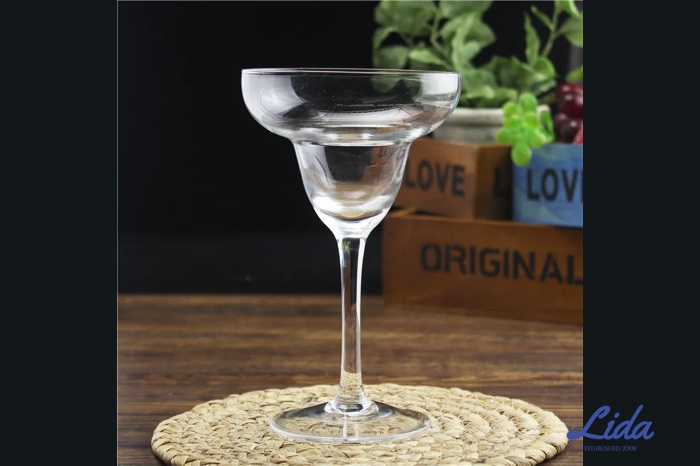
Margarita Glass Sizes: Two Lida Models for Bar Buyers
Lida currently lists two named Margarita glasses in its cocktail range. Machine-made GJ-5505 has a listed capacity of 185 ml (about 6.3 US fl oz), a 160 mm height and a 98 mm rim. Hand-blown ZCTGX0012 lists 200 ml (about 6.8 US fl oz), a 157 mm height and a 95 mm rim. The figures are close, but the glasses have different shapes and production routes. A bar or distributor should approve the actual model and packing, not order only by the phrase “Margarita glass.”
The capacities below describe the full glasses. They are not instructions for how much Margarita to pour. Finished drink volume, ice, garnish and any rim treatment belong in the buyer's own service brief. Use the measurements to shortlist samples, then test the drink and storage arrangement that will actually be used.
Compare the two catalogue models
| Model | Production | Listed capacity | Height | Rim diameter | Base diameter | Listed glass weight |
|---|---|---|---|---|---|---|
| GJ-5505 | Machine-made | 185 ml | 160 mm | 98 mm | 74 mm | 158 g |
| ZCTGX0012 | Hand-blown | 200 ml | 157 mm | 95 mm | 72 mm | 126 g |
ZCTGX0012 lists 15 ml more capacity while standing 3 mm shorter and having a rim 3 mm narrower. Its listed glass weight is 32 g lower. Those differences identify these two models; they do not establish that one production route is stronger, easier to wash or less likely to break. The exact bowl profile and rim finish need a physical sample review.
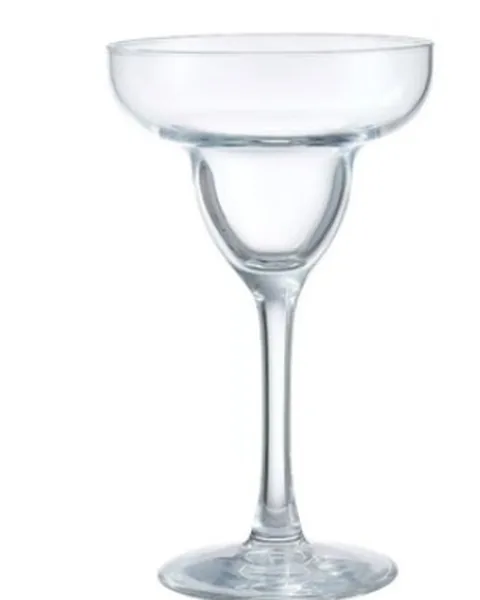
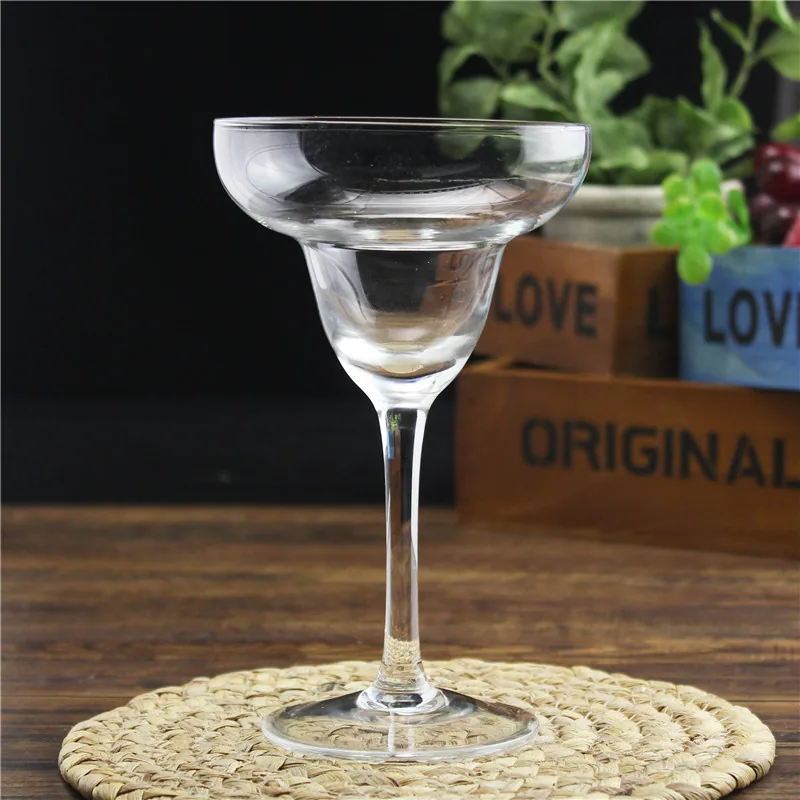
These are separate product photographs, not a scale comparison. Use the listed dimensions and actual samples for measured decisions.
Test the drink you plan to serve
Start with the venue's recipe as served, including dilution or blended ice. Measure the finished liquid or prepared drink rather than working backward from the catalogue capacity. Pour or prepare the same serving in each shortlisted sample. Record the visible fill level, room for a lime wedge or other garnish, and whether a salted or decorated rim can be applied without interfering with service.
A clear drink, a Margarita over ice and a frozen serving do not occupy the bowl in the same way. If the menu uses more than one format, test each one. The 185 and 200 ml catalogue figures cannot predict the space left after ice or a frozen mixture. If neither sample gives the intended presentation, tell Lida which constraint failed and ask for another model rather than treating the catalogue figure as a pour target.
Run the trial where staff will use the glass. Photograph both samples at the same scale on the actual bar counter or tray. Ask staff to lift and carry each filled glass, check how its base sits on the planned coaster, and see whether garnish clears neighbouring drinks. Keep the recipe, finished serving volume, model code and sample photograph together. That record lets a later buyer repeat the selection without relying on memory or a marketing image.
Check racks, shelves and the final pack
The table gives overall height, rim and base diameter, but neither row states the maximum outside bowl width. The widest point of a stepped Margarita bowl may sit below the rim. Measure it on each physical sample before approving a fitted rack compartment or protective insert. A 98 mm rim does not prove that the whole GJ-5505 bowl fits through a 98 mm cavity.
For a rack, provide the clear compartment width, depth and height. For a shelf or tray, also check the foot and the space around neighbouring glasses. For a retail box, provide the intended number of pieces, internal box dimensions and insert arrangement. These are separate fit checks: a glass that clears the shelf may still need a different carton orientation or more room around its bowl.
Ask Lida to confirm the actual pieces per inner and outer pack, carton dimensions, gross weight and protective arrangement for the selected code. A model change or decoration job may change the pack. Before comparing shipping costs, use the final carton data rather than the glass dimensions in the table. Keep the approved packing drawing or physical arrangement with the purchase order.
The 158 g and 126 g figures are listed weights of individual glasses, not shipping-carton weights. Multiplying them by the order quantity would leave out inner boxes, dividers, cushioning and outer cartons. For a mixed shipment, ask for the gross weight and cubic volume of each final packing line so the freight comparison uses the same specification the buyer approved.
Keep model, finish and performance claims separate
GJ-5505 is the machine-made example; ZCTGX0012 is hand-blown. The difference in listed glass weight does not measure resistance to breakage. If the venue needs a particular wash method or durability standard, request evidence for the exact model and finish. Do not transfer a care or performance claim from another cocktail glass merely because its size is similar.
For a retailer or private-label buyer, approve the selected silhouette beside the rest of the cocktail range. Keep the product photograph, model code, logo artwork and final box version together. Ask for the decoration position and care instructions on a decorated sample before printing packaging. The plain sample and the finished branded glass are separate approvals when the surface treatment matters.
If an existing Margarita glass is being replaced, compare its sample and rack or box fit with the proposed Lida model. Similar capacity does not guarantee the same rim profile, stem proportion or base footprint. Record any accepted change as a new SKU or specification version so the customer-facing listing and the next reorder identify the correct glass.
Send a sample and bulk-order brief
Name GJ-5505, ZCTGX0012 or both in the inquiry. Include the intended drink formats, finished serving volumes, approximate quantity and destination. Add any maximum rack height, bowl width, tray footprint or fitted-box dimensions. If one sample failed, describe the failed constraint; “larger Margarita glass” gives Lida less to work with than “the frozen serving plus garnish needs more bowl space.”
For wholesale planning, Lida's category-level guidance starts at 2,000 pieces for selected stocked machine-made models and 3,000 for hand-blown models. Those figures are not a confirmed minimum for GJ-5505 or ZCTGX0012. Ask for the quantity and packing terms of the exact code and any logo or custom box before treating either guide figure as an order commitment.
The Cocktail Glasses collection shows both models in the wider range. Send Lida the chosen codes and constraints to request samples and a model-specific quote. Confirm availability, finish, pack quantity and timing for the chosen code before fixing the order. Keep the approved sample and packing specification for future replenishment.